
🚰 What We Learned at the Potomac Interceptor Meeting
DC Water came to Whitman. Here's what the crowd heard.
If you weren't packed into Walt Whitman High School Thursday night for the DC Water community meeting on the Potomac Interceptor collapse, here's the short version: the emergency repair is nearly done, drinking water was never affected, and the river is recovering faster than expected. The longer version involves $625 million in planned infrastructure investment, frozen pumps clogged with flushable wipes, and a room full of residents who had more questions than 30 minutes of Q&A could hold.
Congressman Jamie Raskin hosted the packed session alongside Glen Echo Mayor Dot Costello, with DC Water CEO David Geddes, COO Matt Brown, WSSC CEO Kishia Powell, and officials from Maryland's Department of the Environment and Montgomery County's health department all on hand.
Here's what matters most for our neighbors along the river.
Quick recap of what happened
On January 19, a structural collapse in the 72-inch reinforced concrete pipe near the American Legion Bridge caused raw sewage to surge out of a manhole, flow over land, and pour into the Potomac River. DC Water estimates approximately 243 million gallons of untreated wastewater overflowed before containment, making it one of the largest sewage spills in U.S. history. The pipe, built in the early 1960s by an act of Congress, carries wastewater 54 miles from Dulles Airport through Montgomery County and into DC for treatment at Blue Plains.
DC Water's COO Matt Brown explained that the collapse appears to have been caused by oversized rock fill placed on top of the pipe during original construction. Blasted rock from tunneling was used as backfill instead of the standard three-inch-or-smaller material. Over six decades, that rock shifted and crushed the pipe inward, creating a complete blockage.
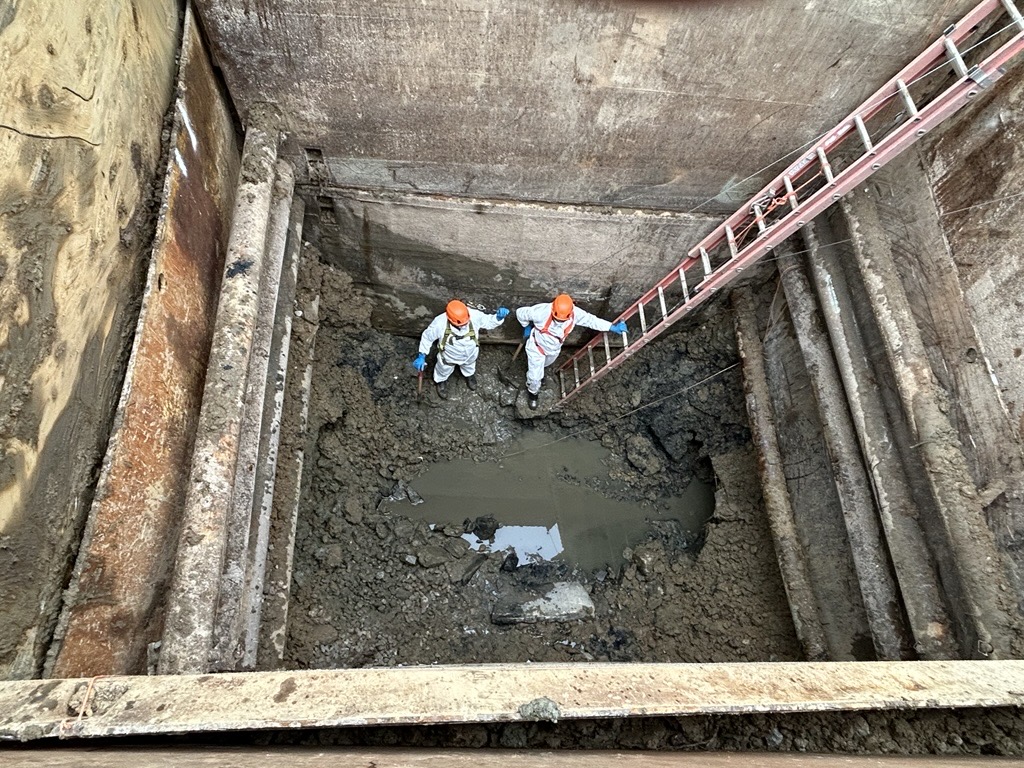
DC Water crews excavate the collapsed section of the Potomac Interceptor, 15-20 feet below ground near Clara Barton Parkway. Photo: DC Water
The emergency response timeline
The numbers tell the story of an escalating engineering effort:
Jan. 19-24: Before bypass pumps were operational, an estimated 40 million gallons per day flowed into the river.
Jan. 24: Six large bypass pumps came online, routing wastewater through the C&O Canal and back into the interceptor downstream. Overflow dropped to roughly 5 million gallons per day, hampered by pumps freezing and clogging with grease and wipes in sub-zero temperatures.
Jan. 27: Additional pumps brought capacity to 60 million gallons per day, further reducing overflow.
Jan. 28-Feb. 9: Total overflow during this window was 1.5 million gallons.
Feb. 8 to present: Zero overflows reaching the Potomac River.
The system now has over 130 million gallons per day of pumping capacity. Crews have been excavating the rock blockage and plan to apply a spray-on concrete lining called geo polymer to reinforce several hundred feet of pipe on either side of the break. Brown said the emergency pipe repair should be complete by mid-March, at which point flow returns to the interceptor and the canal can be drained for cleanup.
Your drinking water is fine
WSSC CEO Kishia Powell was emphatic: Montgomery County's drinking water comes from the Potomac Water Filtration Plant, which draws from well upstream of the break near Great Falls. That intake has been continuously monitored since the incident with no concerns identified.
The Washington Aqueduct's Little Falls intake, which is downstream of the break, has been taken offline as a precaution. An Army Corps representative confirmed that Great Falls has two redundant intake systems operating normally and Little Falls is "a backup to the backup" that is rarely used.
River water quality is bouncing back
DC Water has been sampling at eight locations from upstream of the break down to National Harbor. E. coli readings that initially spiked well above the EPA's 410 colony-forming-units recreational safety threshold have returned to normal range at most downstream locations. Levels remain elevated closest to the break site but are trending down.
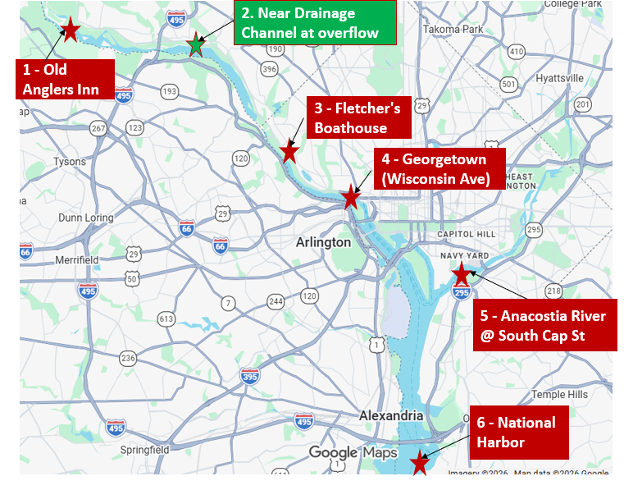
DC Water's eight sampling sites stretch from Old Anglers Inn (upstream) to National Harbor. Map: DC Water
Adam Ortiz, deputy secretary at Maryland's Department of the Environment, emphasized that the Potomac's robust flow of roughly 7 billion gallons per day is working in the community's favor. He noted the river is 1,200 feet wide near the break and nearly a mile wide further downstream, providing enormous dilution capacity compared to tidal waterways where pollutants tend to linger.
Maryland also lifted its precautionary shellfish harvesting suspension, with harvesting areas (about 50 miles downstream) reopening March 10.
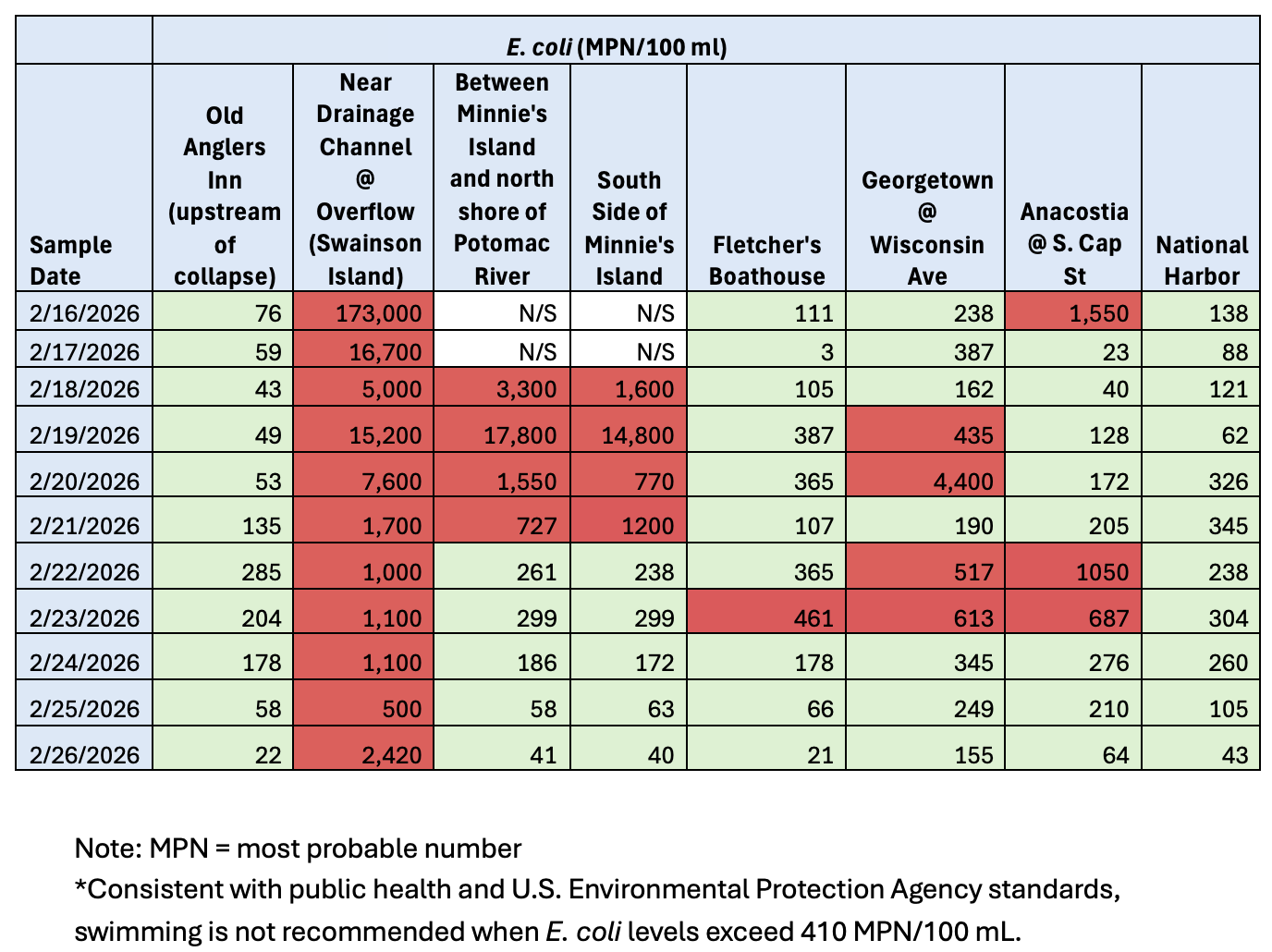
Daily e. coli readings across all eight sites. Green = below the 410 MPN/100ml safe-recreation threshold. Red = above. Note the dramatic improvement at most locations over the past 10 days, with the overflow site (Swainson Island) still elevated. Data: DC Water
What about the towpath, the canal, and the smell?
Four cleanup zones have been identified: the initial overflow area near Clara Barton Parkway, the tributary drainage channel, the Potomac shoreline near the break extending to Sycamore Island, and the C&O Canal bypass area itself.
DC Water's environmental team said Phase 1 cleanup of the uncontrolled overflow areas (zones 1-3) could begin as early as next week, focusing on visible debris and contaminated material removal. Canal cleanup must wait until flow is routed back into the repaired interceptor.
The smell is real but not dangerous. Montgomery County Health Officer Dr. Keisha Davis said the odor itself does not carry infection risk. The health concern is direct contact with contaminated water or soil, not airborne exposure. People sensitive to strong odors may experience headaches and should avoid the immediate area.
Rowing, kayaking, and getting back on the water
This was the question on many minds. DC's Department of Health has set March 3 as the target date for recreational activities like rowing and kayaking to resume in DC's portion of the river, based on sustained e. coli readings below the 410 threshold. Dr. Davis recommended extra precaution for rowers and paddlers on the Maryland side: wash hands and face with soap and water after coming off the water, and discourage splashing. She would not yet encourage kids playing in mud along the shoreline near the break.
The Potomac Whitewater Racing Center raised the concern that no testing is currently happening below Little Falls Dam, one of the most popular kayaking stretches on the river. Multiple attendees requested expanded and more transparent testing, including sediment sampling, not just water column testing.
Who pays for all this?
This is where it gets interesting for Montgomery County ratepayers. The Potomac Interceptor cost-sharing formula, based on wastewater flow volume from each jurisdiction, breaks down like this:
| Jurisdiction | Cost Share |
| Fairfax County | ~45% |
| WSSC (Montgomery County) | ~30.9% |
| Loudoun County | ~19% |
| Other users | ~4.4% |
| DC Water / District of Columbia | 0% |
That zero raised eyebrows. DC Water's 0% share applies because the break occurred outside the District. WSSC's Powell noted that DC Mayor Muriel Bowser requested 100% federal reimbursement through FEMA, and WSSC's position is that any federal funds received should reduce costs for the jurisdictions actually paying. A FEMA emergency disaster declaration has been granted.
On the federal side, Congressman Raskin said the Maryland, Virginia, and DC congressional delegations have requested $395 million in the Water Resources Development Act of 2026 for Potomac Interceptor improvements.
DC Water's total 10-year capital improvement plan is $10 billion, with $625 million earmarked for the interceptor.
The big-picture concern
Several residents pushed hard on a fundamental design problem: a single 60-year-old pipe with no redundancy carrying waste from half a million people. One Cabin John resident put it plainly: the pipe was a bad design from 1965, the people who made those decisions are long gone, and DC Water needs to build parallel capacity rather than just patch what exists.
DC Water acknowledged the lack of redundancy and said they are studying the question. Geddes pointed to successful redundancy projects in DC's system and said the concept is being evaluated for the interceptor, though he noted the cost would be substantial. WSSC's Powell stressed that her agency must be at the table for those long-term planning discussions given Montgomery County's significant cost share.
DC Water is also conducting emergency inspections of 22 high-priority locations along the full 54-mile interceptor, focusing on elevation changes where corrosive sewer gases could thin pipe walls. Brown said over 70,000 linear feet have been surveyed so far with no emergency conditions found, and the capital plan will be reordered based on findings.
What's next
DC Water committed to another community meeting, potentially within two weeks, and said future sessions will include more Q&A time. Several attendees and Mayor Costello requested that the National Park Service attend the next meeting given the impact to the C&O Canal. All presentation materials will be posted on DC Water's website, and a consolidated monitoring data dashboard with all agency testing results is in the works.
For ongoing updates: dcwater.com and search "Maryland Department of the Environment Potomac Interceptor" for the state's monitoring portal.